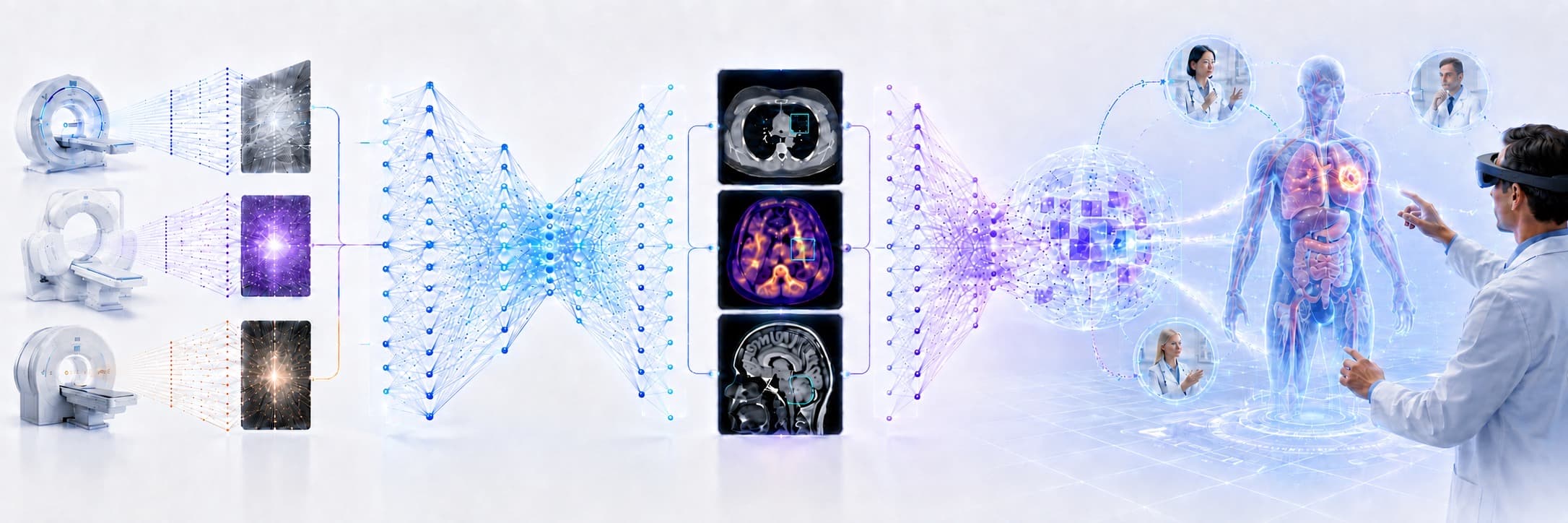
This course serves as an advanced introduction to medical imaging with a focus on the physical, mathematical, and computational principles underlying modern imaging systems. Fundamental concepts of image formation, tomographic data acquisition, and image reconstruction are covered, along with the design and operation of major imaging modalities such as x-ray computed tomography, magnetic resonance imaging, and related technologies. The course also addresses contemporary artificial intelligence and deep learning methods for medical imaging, including learning-based image reconstruction, image analysis, and emerging clinical and research applications.
How this course is taught
The AI avatar teaches, asks, evaluates, and remediates. An AI instructor in your professor's own voice delivers every lecture, pauses to ask you questions, grades your free-form answers with formative feedback, and a personal AI tutor picks up wherever you struggle. The human instructor monitors progress and curates the content.
Course syllabus
BMED 4590/6590, Medical Imaging
Credits and Contact Hours
4 credits, 4 contact hours
Instructor and Coordinator
Ge Wang
Textbook(s)
1. Fundamentals of Medical Imaging, Second Edition
Paul Suetens
Cambridge University Press, 2009
2. Machine Learning for Tomographic Imaging
Ge Wang, Yi Zhang, Xiaojing Ye, and Xuanqin Mou
IOP Publishing, 2019
Supplemental Materials
Additional journal articles, lecture notes, research papers, and educational resources will be provided throughout the course and made available through the course learning management system.
Catalog Description
This course provides an in-depth introduction to modern medical imaging, covering the physical, mathematical, computational, and engineering principles underlying major imaging modalities. Emphasis is placed on image formation, tomographic data acquisition, image reconstruction, and clinical applications. The course also introduces state-of-the-art artificial intelligence (AI) and deep learning (DL) methods for medical imaging, with particular attention to learning-based and data-driven tomographic reconstruction techniques. Students will gain both theoretical understanding and exposure to current research developments in medical imaging.
Prerequisites
BMED 2300 Bio-Instrumentation and Bio-Imaging, or equivalent background in biomedical imaging and instrumentation.
Course Classification
Elective undergraduate course and graduate course in Biomedical Engineering and related disciplines.
Course Outcomes
Students who successfully complete the course should be able to:
Student Outcomes
BME Program Criteria
Topics
Neural networks and deep learning; x-ray physics and imaging components; filtered backprojection; computed tomography (CT); cone-beam CT; spiral CT; interior CT; spectral CT; iterative reconstruction; learning-based image reconstruction; Maxwell equations; Bloch equations; magnetic resonance imaging (MRI); pulse sequences; image formation and reconstruction; advanced medical imaging modalities; artificial intelligence applications in medical imaging; and current research trends in medical imaging.
Software Requirements
Programming assignments and computational exercises may require the use of Python, TensorFlow, or equivalent machine learning and scientific computing software.
Grading Policy
Optional project-based credit may be awarded at the instructor's discretion.
Academic Integrity
Students are expected to uphold the highest standards of academic honesty and professional conduct. All submitted work must represent the student's own effort unless collaboration is explicitly authorized. Any form of academic dishonesty, including plagiarism, cheating, fabrication, or unauthorized collaboration, may result in disciplinary action according to university policies.
Course Format
This course consists of lectures, demonstrations, programming exercises, homework assignments, examinations, and discussions of current research topics. Students are expected to actively engage with course materials and complete all required assignments to reinforce their understanding of medical imaging principles and applications.
Start with the first lecture
1. Medical Imaging
Watch the free preview24 more lectures unlock when your enrolment is approved, along with the quizzes, your notes, the discussion board and the AI tutor.
Student reviews
No reviews yet.